

Rescuing 20 Years of Data to Understand How Andean Trees Respond to Climate Change By Andrea Chávez
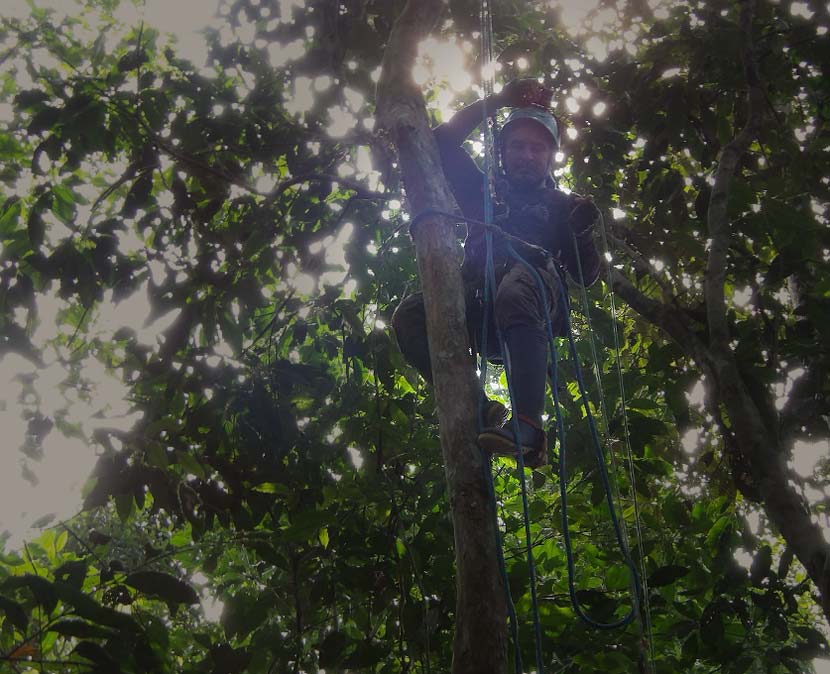
In its leaves, each tree holds a chemical memory of everything it has experienced: the rains, the droughts, the warmest and coldest years. That memory is precisely what we went to find. The green sky of Selva Viva, seen from below the canopy, and our climber Efrain at work.
Back to Selva Viva
I am a doctoral student at the National Polytechnic School (EPN) and Ghent University, Belgium, in an inter-institutional cooperation program funded by VLIR-UOS. My research seeks to understand how Andean mountain trees are reacting to climate change, combining tools such as monitoring permanent growth plots and stable isotope analysis.
Selva Viva is one of the key locations for completing this story. Twenty years ago, my supervisor, Dr. Jürgen Homeier, and his team established several permanent study plots in this area of extremely high species diversity. The last census was conducted in 2011. Since then, thirteen years of silence: no one had measured these trees again. In 2025, we set out to recover that information.
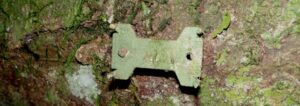
Original plaque installed in 2006 when the censuses began in Selva Viva.
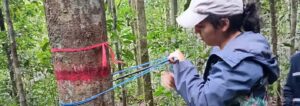
Collection of wood samples to estimate wood density.
What did we measure, and what’s next?
In the field, we collected data on diameter growth and species diversity in the recovered plots. We selected certain trees from which we collected leaves to preserve in herbaria, and also to record data on size, weight, etc. These samples were also transported to Ghent University, where they were processed to measure δ¹³C (delta carbon-13), a stable isotope that occurs naturally in the atmosphere. When a plant photosynthesizes, it discriminates between different carbon isotopes based on how it manages the balance between water and carbon—basically, based on how much water it “saves” by opening or closing its stomata. Measuring this ratio in wood allows us to reconstruct, over the years of sampling, how this water-carbon relationship has changed in the tree over time.
The next step is to compare the results from Selva Viva with those from an entire altitudinal gradient across the Ecuadorian Andes, to understand if trees at different elevations are responding differently to climate change.
Two trips, many species, and data that could not have been collected without the help of the local community.
The work was done over several visits, in February and September 2025. Selva Viva is so diverse that, when processing the initial identifications, we found errors that we could only resolve by revisiting the trees in person. The richness of species that makes this forest so scientifically valuable is the same richness that makes identification a constant challenge.
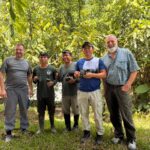
Furthermore, field science is rarely just science: it’s also logistics, trust, and hospitality. The field team consisted of Karina, our field leader, the tree climber Efraín—indispensable for reaching the highest canopies—and students Leyly, Valentina, and Martín. No permanent plot can be measured without climbing, literally, to where the tree lives. In the area, Lester helped us reconnect with the region after so many years without visits. Joëlle and Miguel welcomed us to the local school, which became our nighttime operations center—there we processed samples and measured functional traits after dark—and they also transported us to the plots. Elder and Rubén were the guides who accompanied us on every outing.
Thanks to this work, we are generating unique data for the region, information that stopped being collected in 2011 and that we can now bring back to light. I’m still working on this “Goliath” that is my PhD, processing samples and refining analyses, but I hope, in the not-too-distant future, to be able to share these results with the community that made them possible.
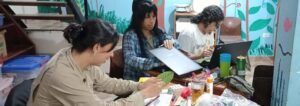
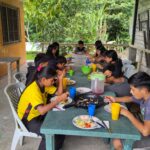
The base of operations, at night, measuring functional traits.